For your portfolio, probably less than the headlines suggest. Over time, markets have been driven by earnings, productivity and interest rates far more than by which party controls Congress. The bigger effect is on taxes: with divided government, major tax changes look unlikely over the next two years, which gives you a stable window to plan.
The midterm results are in. Democrats secured control of both the House and Senate. When the new Congress is seated in January, unified Republican control ends and we enter a period of divided government for the final two years of President Trump's term.
A tale of two economies
Many observers read the results as a verdict on affordability. Consumer sentiment hit a record low this spring as supply disruptions in the Strait of Hormuz pushed gasoline prices higher, and 30-year mortgage rates are still above 7%. For a lot of households, the economy has felt expensive.
The broad numbers tell a different story. The initial estimate shows the economy grew at a 3.4% annual pace in the third quarter, with consumer spending up 3.8%.
Both things are true at the same time. How the economy feels at the gas pump and the grocery store is often different from what drives corporate earnings and markets. Good financial decisions start with keeping those two ideas separate.
Divided government is normal
Split control of Washington is common. Recent midterms produced divided government under Presidents Clinton (1994), George W. Bush (2006), Obama (2010), Trump (2018), and Biden (2022). In most of those periods, the economy and markets kept growing.
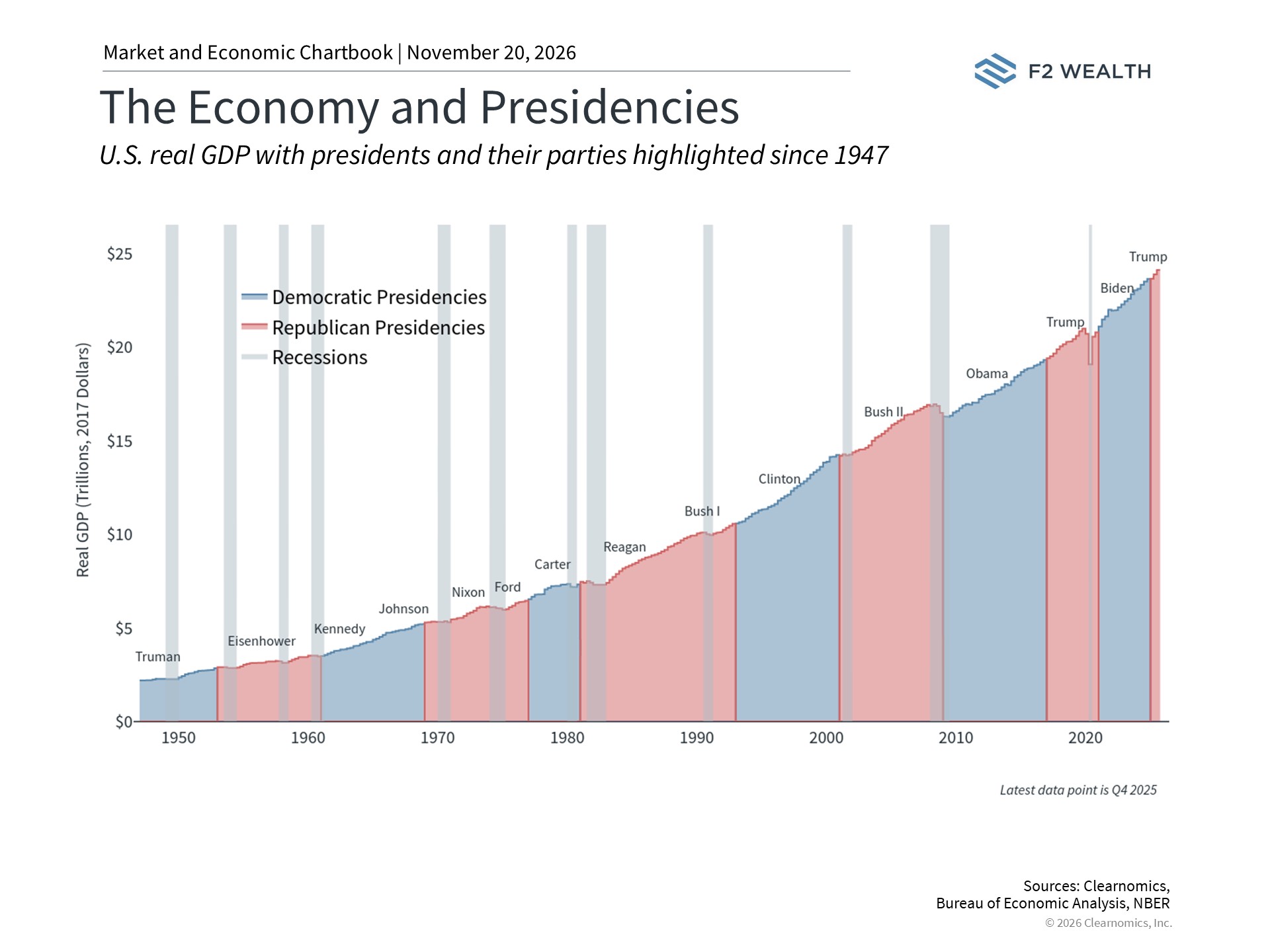
The practical effect of divided government is that sweeping legislation becomes harder to pass. That can mean gridlock. It also tends to mean fewer surprises, which businesses and markets generally welcome.
What history does, and doesn't, tell us
Market history offers a pattern for almost any political outcome. Since 1937, a Republican president with divided government has produced the lowest average annual return for the S&P 500, at 9.4%. That's the setup Washington will have in 2027. Yet the third year of a presidential term has been the strongest of the four, averaging 19.4%, and 2027 is the third year of this term.
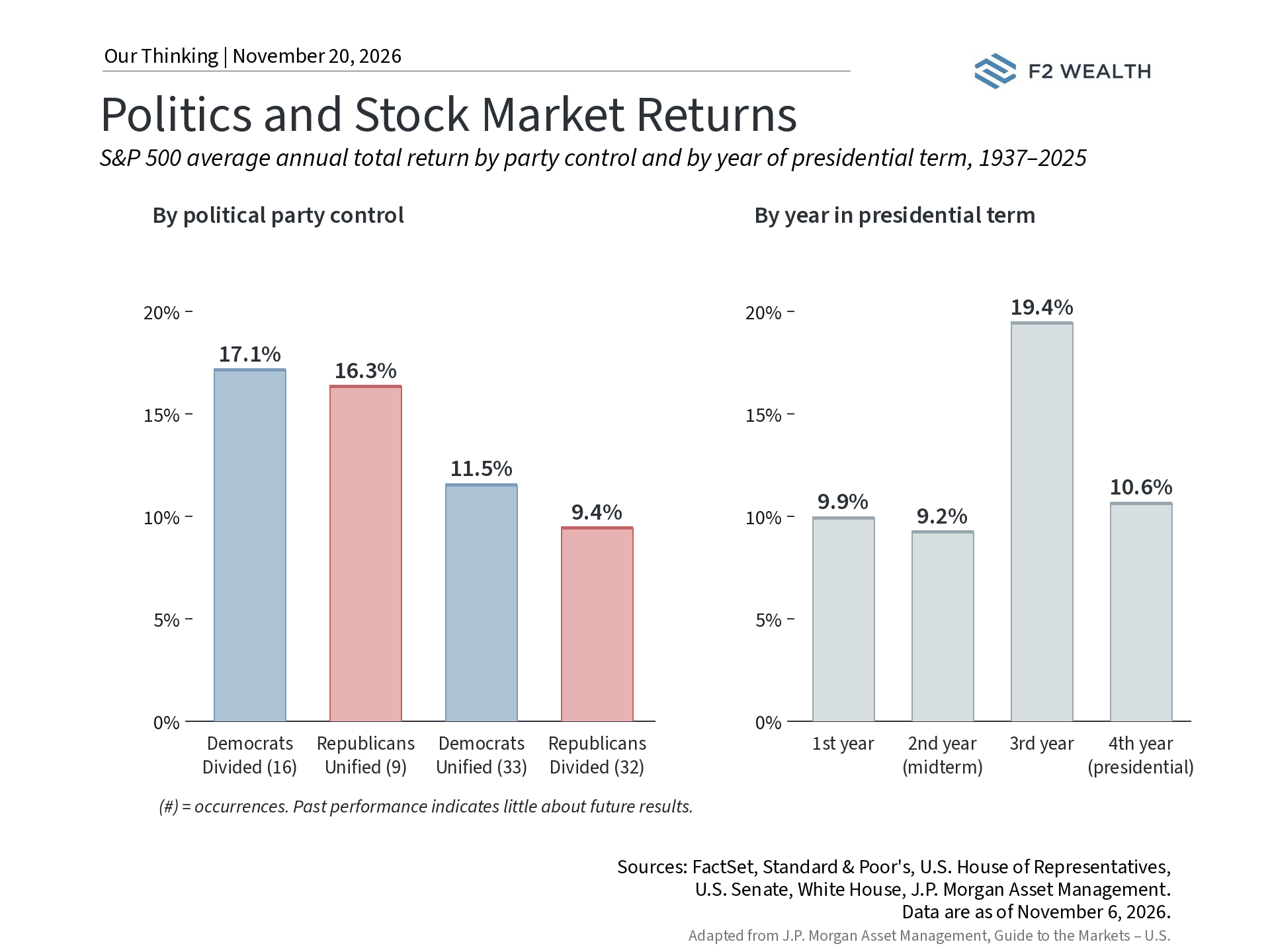
So history points in both directions at once. We pay attention to both patterns and base decisions on neither. Each rests on a small number of years (as few as nine for one of the categories in the chart), and neither accounts for earnings, interest rates or valuations, which are what actually drive returns.
We pay attention to both patterns and base decisions on neither.
The weeks right after this election made the point. Stocks rallied the day after the vote, then the S&P 500 fell 4.4% on November 5, its worst day since April 2025. That selloff was centered on AI-related companies and reflected worries about valuations, interest rates, and data center policy at least as much as politics.
Three things we're watching
Taxes: a stable runway
This is where the election matters most for our clients, and the news is largely reassuring. The 2025 tax law (the One Big Beautiful Bill Act) made many individual tax provisions permanent. With a president who can veto and a Congress that can block, major tax changes in either direction look unlikely over the next two years.
That gives us something planners rarely get: a reasonably predictable tax code. For anyone weighing Roth conversions, the timing of a business sale, or the shift from paychecks to retirement income, that's an opportunity to plan deliberately instead of reacting to deadlines. The 2028 election is the next real turning point, and we're planning with that in mind.
The debt ceiling
The federal borrowing limit will need to be raised again, and analysts expect the deadline to land sometime in the second half of 2027. Past standoffs, most notably in 2011, caused bouts of volatility without derailing long-term returns. For clients drawing income from their portfolios, this is exactly why we keep cash reserves in place, so no one is forced to sell during a headline-driven dip.
Data centers, close to home
Ohio ended up at the center of a debate few people saw coming. More than half of the data center measures on local ballots this year were in Ohio, and nationally, voters sided with limiting data center development in 46 of the 47 measures decided so far.
AI infrastructure spending has been a major contributor to economic growth and corporate profits. Whether local resistance slows that build-out remains to be seen. Either way, it's a reminder that a stock market heavily concentrated in a few AI-related companies carries real risk. If you hold a concentrated position, whether in employer stock or a handful of technology names, this is a good time to revisit it.
Keeping politics and portfolios separate
Elections matter. They shape policy, and policy shapes the details of a financial plan, especially on the tax side. Over time, though, markets have been driven by earnings, productivity, innovation, and interest rates, not by which party holds which chamber.
That's why we build plans designed to hold up across many environments instead of betting on one outcome. If you'd like to talk through what this means for your situation, we'd welcome the conversation.
This article is for educational purposes only. It does not represent investment advice. It is not a solicitation for advisory services nor is it intended to be used as investment, tax, legal, accounting, insurance, or financial planning advice. References and/or links to third parties do not constitute an endorsement. We have no relationship with any third party referenced in this article. Consult with us or another qualified professional before acting on any of the information presented herein.